Validating Kubernetes Resilience: Veeam Kasten on Rocky Linux

Over the past few weeks, I’ve been building out a Kubernetes platform on Rocky Linux using Rancher to evaluate modern backup and recovery approaches. A primary goal was to validate Veeam Kasten in a live environment.
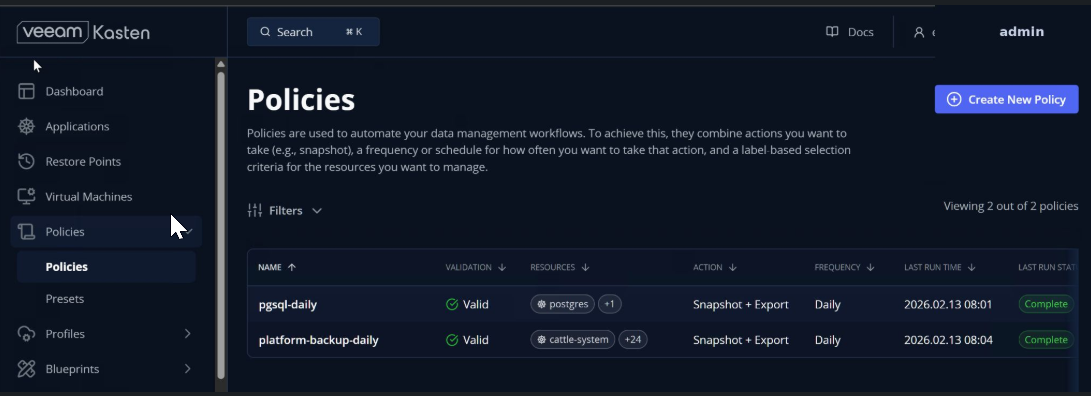
After deploying Kasten and integrating it with object storage, I implemented policy-driven protection for both platform services and stateful workloads. This included PostgreSQL running on persistent storage backed by Longhorn.
What Stood Out During Validation
A few things became clear as soon as the first policies were struck:
- Predictable Policy Model: Kasten’s model is straightforward. Defining automated snapshot and export policies at the namespace or platform level is simple and predictable.
- Application-Aware Protection: This is where the real value lies. Backing up Kubernetes is not just about copying volumes; you need to capture the application state to ensure consistent, reliable recovery.
- Platform Resilience: Protecting core platform namespaces is often overlooked. Protecting the operational components of the cluster itself adds a critical layer of resilience.
- Off-Cluster Portability: Integration with object storage makes off-cluster recovery practical, which is a non-negotiable requirement for any serious DR strategy.
Speed to Operational Readiness
What impressed me most was how quickly protection became operational. Once the profiles and policies were configured, the system ran automatically without additional manual effort.
In my testing, I was able to see successful, "Valid" protection runs for both my pgsql-daily and platform-backup-daily policies almost immediately.
The Shift in Recovery Thinking
Kubernetes fundamentally changes how recovery needs to be approached. It is no longer about protecting servers; it is about protecting the applications, their data, and the platform configuration as a single, cohesive unit.
While I am still early in the testing phase, Kasten has performed exceptionally well and delivered exactly what I needed to see for a production-grade environment.