

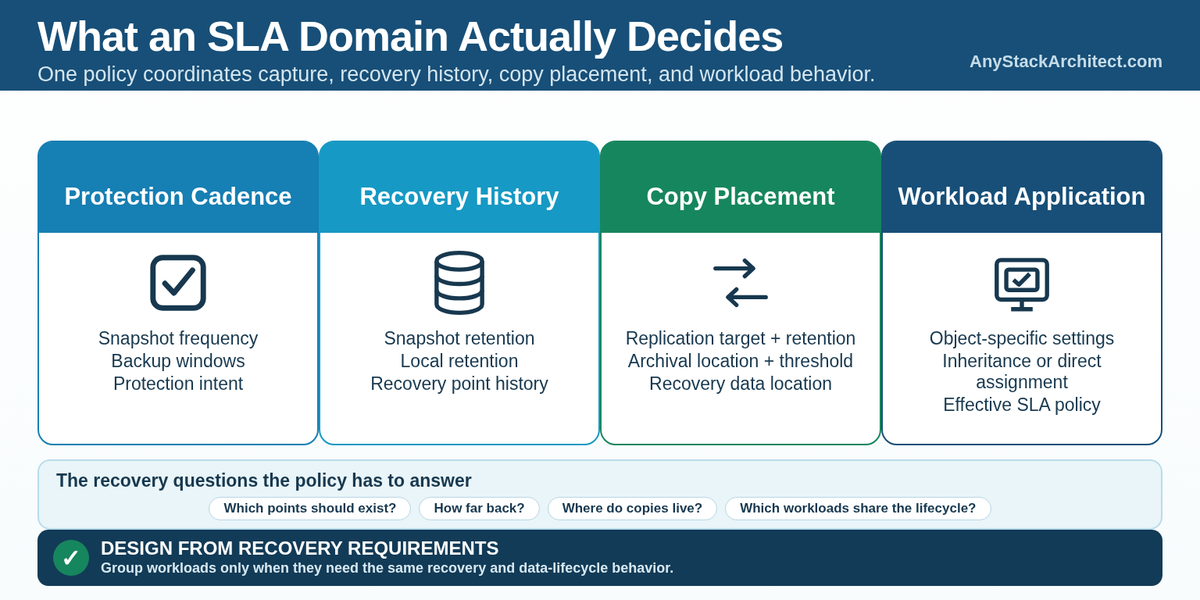
Most Rubrik designs eventually reach the same question: how often does this workload need a backup? It is a necessary question, but it is too small to design an SLA Domain around.
Documented Rubrik Security Cloud uses SLA Domains as data protection policies. Rubrik documents frequency and retention, but the policy model also includes replication destinations, archival locations, workload types, object specific settings, backup windows, local retention limits, and other lifecycle controls.[1] If the design starts and ends with a schedule, most of the policy has been treated as an afterthought.
That question forces frequency, retention, copy placement, workload behavior, and policy assignment into the same design discussion. It also exposes where a neat Gold, Silver, or Bronze label is hiding requirements nobody has actually defined.
The Schedule Is Protection Intent
A configured frequency describes when protection should occur. It does not prove that a usable recovery point was created at every intended interval.
Documented Rubrik makes that separation visible in RSC reporting. The Object Backup Task Summary compares expected tasks from the assigned SLA Domain with succeeded, failed, canceled, missed, on time, and late tasks.[2] A policy can therefore say what should happen while operations show what actually happened.
That is the first place I separate policy configuration from business RPO. An hourly protection frequency may be one input to a one hour recovery point objective, but the configured interval by itself is not evidence that the business always has a recovery point less than an hour old. Successful execution, workload consistency, application specific log capture where required, and the dependencies needed to perform recovery still matter.
For vSphere, for example, Rubrik documents ordinary VM protection at the hypervisor layer and uses Rubrik Backup Service when an application needs consistency beyond basic VMware VSS quiescing, such as database aware quiescing or pre and post scripts.[3] Changing the clock does not replace that workload requirement.
A defensible design therefore has two separate statements: what protection interval the SLA is intended to maintain, and how the environment proves the resulting recovery points meet the workload's recovery requirement.
Frequency and Retention Build the Recovery History
Frequency answers how densely Rubrik is asked to create recovery points. Retention answers how much of that history remains available. The two values only make sense together.
A workload can need dense recent recovery points and a much longer recovery history for a completely different reason. Operational mistakes, data corruption, application defects, or a destructive event may not be recognized when they first occur. If the organization may need to reach back before the first known bad state, the retained history has to extend far enough to provide that option.
Longer retention does not identify a clean point, guarantee that a point is usable, or make an application recoverable by itself. It preserves more history from which the recovery process can choose. That distinction matters during cyber recovery because keeping older points and determining which point is safe to use are separate problems.
Retention also consumes something. The exact storage behavior depends on workload and target, but a longer history, additional replicated retention, or additional archived copies has capacity and cost consequences somewhere. The recovery requirement should justify the history before the storage architecture is asked to absorb it.
Rubrik's SLA model supports multiple schedule frequencies and associated retention values, plus local retention and copy specific retention controls.[1] I would use those controls to express a recovery history deliberately, not to build a collection of numbers that happen to fit inside the wizard.
Replication and Archival Make It a Placement Decision
An SLA Domain can include replication and archival alongside the base protection schedule.[1][5] Once those properties are present, the policy is deciding where recoverable data should exist, not only when another point should be created.
Replication policy includes a target and retention for replicated snapshots. Archival policy includes an archival location and lifecycle settings such as an archival threshold.[1][6] Those settings change which copies can be available at another location and how long they remain there.
Architecture point I would not assume every retained point has the same recovery path simply because it belongs to the same SLA Domain. A point retained locally, a replica at another target, and a point that has moved into an archive can satisfy different recovery needs and may involve different infrastructure, access, and timing during recovery. The SLA design should make those differences intentional.
This is also where local retention deserves more attention than it usually gets. If the business expects a recent point to be immediately available from the primary protection environment while older history can live elsewhere, that is a lifecycle decision. If the primary Rubrik environment or site is unavailable, the design needs to identify which other copy is expected to carry the recovery and for how long.
The full replication versus archival design goes deeper than this article needs. The important point here is that both are properties of the protection policy, so copy location belongs in the SLA Domain discussion from the beginning.
Assignment Is Part of the Design
Policy design is incomplete until the architect knows how workloads receive the policy.
Rubrik supports hierarchical behavior for several workload types. In vSphere, an SLA Domain assigned at the vCenter, compute cluster, or folder level is inherited by the VMs below it.[3] RSC's API also distinguishes direct and inherited SLA assignment and exposes the effective SLA Domain and the object from which that effective policy originates.[7]
Inheritance is useful because a new VM can enter a protected part of the hierarchy without somebody remembering to assign protection manually. It can also hide intent when administrators only look at the VM and see the effective policy without knowing why it was inherited from that location.
Operational view During an SLA audit, I want to know both the effective policy and the source of the assignment. If the answer to "why does this VM have this SLA?" requires guessing which object higher in the hierarchy supplied it, the policy model is already becoming harder to operate than it needs to be.
Explicit exceptions have the opposite tradeoff. They can represent a real workload requirement, but every override weakens the assumption that a hierarchy maps cleanly to a recovery class. Exceptions should exist because the workload's recovery lifecycle is different, not because an administrator wanted a slightly different schedule once.
Rubrik also exposes controls that can affect whether policy changes apply to existing snapshots. The SLA assignment API includes an option to apply a new assignment to existing snapshots, and RSC replication policy editing includes an Apply to existing snapshots choice for retention changes.[1][6] A policy change is therefore not something I would treat as a label swap. Existing recovery points and new recovery points may need deliberate handling during the change.
Workloads That Share a Tier May Not Share a Recovery Lifecycle
One of the fastest ways to create weak SLA architecture is to invent three tiers first and push workloads into them afterward.
There is nothing inherently wrong with names such as Gold, Silver, Bronze, Tier 1, or Tier 2. The problem starts when the label becomes the requirement. "Gold" does not tell me which recovery points must exist, how much data loss is acceptable, how long history must remain, where another copy must live, whether database logs are required, or what happens when the primary protection site is unavailable.
Rubrik itself has workload specific SLA settings. Current RSC documentation lists examples such as transaction log retention for SQL Server, log frequency and retention for Oracle, log retention for PostgreSQL, and other object specific controls.[4] The SLA Domain model also exposes object specific configuration in the API.[1] Two workloads can therefore share the same headline snapshot frequency and still require materially different protection behavior.
This is why I group workloads by recovery lifecycle rather than by how important somebody says they are. A core transactional database, a standard infrastructure VM, a development system, and a long retention records workload may all be "important" to different people. That word is not enough to put them in the same policy.
A better grouping test is whether the workloads genuinely need the same capture cadence, retained history, copy placement, workload specific behavior, and operational ownership. If those answers line up, one SLA Domain can express a reusable recovery policy. If they do not, a shared tier name is hiding the difference.
Policy Sprawl Hides Intent
The opposite failure is creating a new SLA Domain every time one workload asks for one small variation.
There is no correct universal number of SLA Domains. An environment with five defensible recovery patterns can be cleaner than one with three vague tiers, and an environment with more than five may be completely justified. The design problem is policy count without a clear recovery reason.
Narrowly different policies create operational friction. Audits have more policies to interpret. Exceptions become normal. Administrators have a harder time determining why a workload has its current settings. Small retention or replication differences can survive long after the application that required them changed or disappeared.
RSC reporting can expose the SLA Domain assigned to an object along with expected and actual protection task outcomes.[2] Tools make the state visible, but they do not give the state a business reason. That part belongs in the architecture.
I would rather defend each SLA Domain with one clear recovery statement than maintain a catalog of nearly identical policies. If two policies differ, somebody should be able to explain the recovery requirement that makes the difference necessary.
Design From the Recovery Requirement
I normally work backward from the state the application must be recoverable into. The schedule comes later.
| Recovery question | SLA design consequence |
|---|---|
| How much new data loss can become unacceptable? | Establish the intended protection interval, then define how compliance with the business RPO will be measured. |
| How far back might recovery need to go? | Define the recovery history and retention required to reach older points when a problem is discovered late. |
| Where must a recoverable copy exist? | Decide whether local protection is enough or whether replication, archival, or both belong in the policy. |
| Which copy is expected to serve a site level recovery? | Align copy placement and retention with the recovery location and the infrastructure available there. |
| Does the workload need application specific protection behavior? | Include the workload specific SLA settings and consistency mechanisms the application actually requires. |
| Which workloads can inherit the same policy safely? | Group only workloads that share the same recovery lifecycle, then use hierarchy or explicit assignment deliberately. |
| What happens when requirements change? | Decide how the change affects future points, existing points, assignments, capacity, and recovery testing. |
A core production database might need dense recent points, database log protection, a longer history for point selection, and a remote copy because its recovery plan includes another site. A standard infrastructure VM estate may be able to inherit a common SLA from the vSphere hierarchy because those machines genuinely share one lifecycle. A long retention workload may justify a different policy because older history and archival matter more than dense local recovery points.
Those examples are architecture scenarios, not templates. The correct policy comes from the application's recovery contract and the infrastructure available to satisfy it.
What a Defensible SLA Domain Looks Like
A defensible SLA Domain can be explained without opening the Rubrik wizard. The owner can state which recovery points should exist, how far back the history needs to reach, where copies are expected to live, which workload specific behavior is required, how the policy is assigned, and how operations verify that protection is actually succeeding.
The Rubrik configuration then becomes an implementation of those decisions. Frequency still matters. It just does not get to stand in for the entire recovery design.
If the only explanation for a workload's policy is "that is our Gold SLA," the design is not finished.
Source Notes
Product behavior changes. These sources were checked against public Rubrik documentation available on September 24, 2026.