

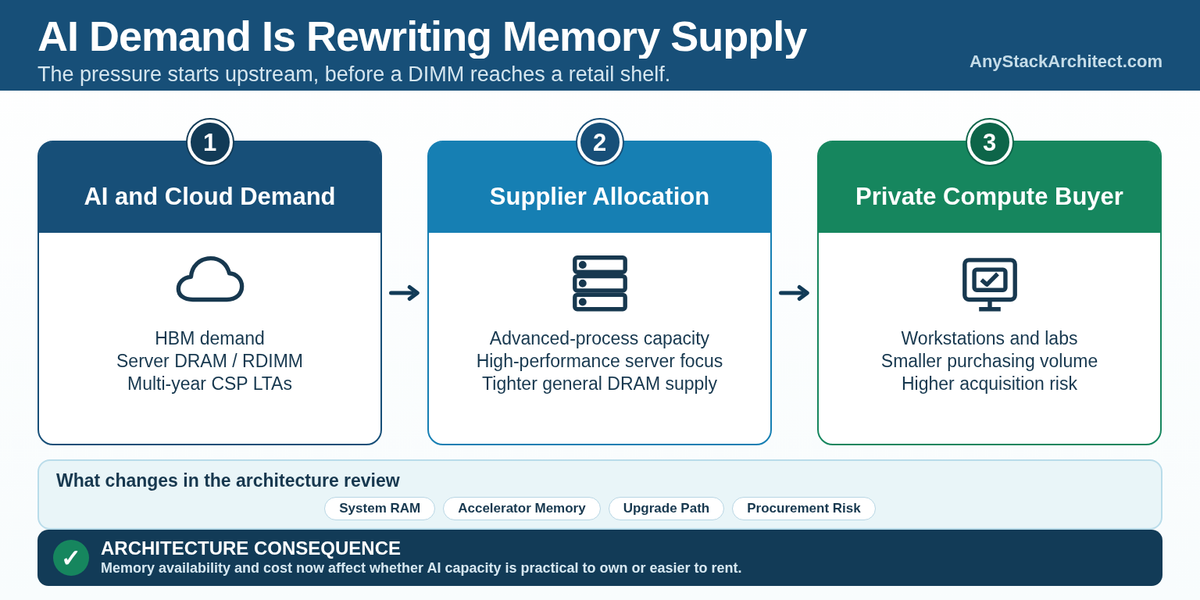
If you are pricing a workstation, lab host, inference server, or virtualization box right now, memory looks broken. TrendForce's module spot data showed a 16 GB DDR5 UDIMM averaging $239 on September 21, 2026. That is a channel spot-market number, not a retail MSRP, but it makes one point very clearly: the pressure is already upstream before a retailer puts a DIMM on a shelf.[1]
The more important number is not the price of one module. On September 30, TrendForce said DRAM suppliers were continuing to prioritize advanced-process capacity for high-performance server products, keeping the market undersupplied. It expects conventional DRAM contract prices to rise another 10 to 15 percent quarter over quarter in the fourth quarter of 2026.[2]
This does not require a conspiracy between memory vendors and AI companies. The market has a simpler mechanism. The largest AI buyers are consuming more HBM and server DRAM, suppliers are moving capacity toward those products, and the buyers with the largest predictable commitments can negotiate supply differently from everyone else.
The Problem Starts Upstream
It is easy to look at an expensive memory kit and blame the reseller. Some of the pain certainly appears in channel pricing, but current industry data shows that the shortage is not being created at the storefront.
TrendForce reported in March that conventional DRAM contract prices were expected to rise 58 to 63 percent quarter over quarter in the second quarter of 2026 as suppliers reallocated capacity toward HBM and server applications.[3] By July, it was still describing the DRAM market as extremely tight and saying consumer customers were reaching their affordability limits.[4]
The fourth-quarter outlook is less violent than the first half of the year, but the direction has not reversed. Capacity is still favoring server DRAM and HBM, and the consumer side is still absorbing the consequences.[2]
A weak consumer market does not automatically produce cheap memory when suppliers have a more profitable place to send the bits.
AI Changes the Product Mix
HBM gets most of the attention because it sits beside the accelerators, but the AI memory story is larger than HBM. AI servers also consume large amounts of conventional server DRAM, and the cloud providers building those systems buy at a scale that changes supplier planning.
TrendForce estimated in August that HBM and RDIMM would account for 51 percent of total DRAM bit supply in 2026.[5] Samsung said its memory business was operating with limited capacity and primarily focusing on server products, while expecting demand for server DRAM, enterprise SSDs, and HBM to keep the market undersupplied through the second half of the year.[6]
Those statements matter because fabs are not abstract pools of infinite capacity. Process transitions, packaging, qualification, equipment, and product mix decisions all take time. When suppliers allocate more output toward high-value server and AI products, another segment gets less flexibility.
I would not reduce that to "HBM stole my desktop RAM." The manufacturing chain is more complicated than that. The useful architecture fact is that AI infrastructure is influencing what memory gets prioritized, how much of it is available to other markets, and what buyers outside the largest contracts have to pay.
Hyperscalers Buy Memory Differently
The purchasing model matters almost as much as the manufacturing model.
TrendForce reported that several U.S. cloud service providers had entered multi-year long-term agreements that restricted suppliers from raising prices for those customers. It also said that, beginning in the third quarter of 2026, more of the server DRAM price increase would shift toward customers without those agreements and toward incremental supply sold outside them.[7]
SK hynix separately reported long-term agreements with around ten key customers as part of its response to structural AI memory demand.[8]
There is nothing mysterious about why a supplier would prefer a multi-year commitment from a customer buying memory by the datacenter. Predictable volume lowers commercial risk. The customer gets supply visibility. The supplier gets a clearer reason to invest in the capacity and packaging those customers need.
The smaller buyer does not negotiate from the same position. A business building a few inference nodes, a university lab, a small cloud, a homelabber, or an individual building a private AI workstation buys what is available after those large commitments have already shaped the market.
Architecture point When the largest buyers can secure memory with long-term volume commitments and smaller buyers purchase from a tighter remaining market, renting AI capacity can become easier to budget than owning the equivalent hardware. That outcome can happen through normal procurement incentives alone.
Private AI Makes Memory Part of the Ownership Decision
Private AI conversations tend to start with the accelerator. Which GPU? How much VRAM? What model can it run? That is only part of the system.
A useful private AI platform also needs system memory for the operating system, model loading and offload strategies, vector databases, retrieval pipelines, containers or virtual machines, observability, security tooling, application services, and whatever else shares the host. The exact footprint varies by model and runtime, but the architecture question is the same one we already know from virtualization and databases: what is the real working set, and what happens when it does not fit?
That is why 64 GB, 128 GB, or 256 GB of system RAM can move from enthusiast territory into a normal design discussion for local inference and mixed lab workloads. The point is not that every AI host needs those capacities. The point is that memory headroom is now part of deciding which workloads can stay local and which ones have to move somewhere else.
Data sovereignty is broader than physical possession of a server. Jurisdiction, identity, encryption, logging, retention, backup, model access, administrative control, and application architecture still matter. Owning the hardware does not automatically solve any of those things.
But hardware ownership gives you an option that does not exist when the workload can run only as somebody else's service. If the cost of enough memory pushes that option out of reach, the sovereignty discussion changes before the first packet leaves the building.
The Cloud Advantage Is Not Only Scale
Cloud AI has obvious scale advantages. A provider can amortize accelerators, power, cooling, networking, storage, engineering, and idle capacity across many customers. Memory procurement adds another advantage.
TrendForce estimates that DRAM and NAND Flash together will represent 47 percent of major CSP capital expenditure in 2026 and 68 percent in 2027.[5] Those percentages are forecasts, not a guarantee, but they show how central memory has become to AI infrastructure spending.
The same report says rising AI demand is prompting suppliers to prioritize limited capacity for server applications.[5] A cloud provider can respond with a large capital plan, long-term agreements, architecture changes, and direct supplier negotiations. A smaller organization normally responds by changing the BOM, delaying the purchase, reducing the memory target, or consuming the workload as a service.
That is the part I would put into an AI placement discussion now. The comparison is not only GPU purchase price versus API price. It is the cost and availability of the whole memory hierarchy over the life of the platform.
Design Around Memory as a Constrained Resource
I would make memory an explicit line item in any private AI architecture review rather than treating it as whatever capacity fits after the GPU decision.
Start with the workload. Measure the model footprint, context requirements, concurrent sessions, retrieval services, caching, application overhead, and the other workloads that will share the system. Decide how much capacity must be accelerator memory, how much can live in system RAM, and what performance is lost when data moves across that boundary.
Then look at the platform itself. DIMM population rules, memory channels, NUMA placement, maximum capacity, supported module sizes, power draw, and expansion paths determine whether a cheap first build can actually grow later. A server that reaches its practical memory ceiling early may force a platform replacement long before the CPUs are obsolete.
Procurement needs the same treatment. Price the system at the capacity you expect to need, not only the minimum configuration that boots the workload. Check whether the chosen DIMM population leaves an upgrade path. If the project depends on adding memory later, that future purchase is a risk that belongs in the design.
I would also keep a service fallback where the workload allows it. Private does not have to mean disconnected from every external option. A system can keep sensitive or predictable inference local while using cloud capacity for bursts, experiments, or models that do not justify a dedicated hardware purchase. The placement decision should follow the data, performance requirement, economics, and recovery plan instead of ideology.
Owning Compute Still Matters
The current memory market does not prove that private AI is dead. It proves that private AI needs a more serious capacity plan than "buy a GPU and run the model locally."
For organizations that care about data location, operational control, predictable inference, disconnected operation, or keeping sensitive workloads away from a third-party service, owning compute can still be the right answer. The economics just need to include memory as a first-class resource.
The direction of the market matters more than one ugly DIMM price. AI infrastructure is pulling memory investment and capacity toward HBM and server products, while the largest cloud buyers can use long-term purchasing agreements that smaller buyers cannot match.[2][7]
If privately owned AI depends on the same components becoming harder and more expensive to acquire, data sovereignty starts carrying a hardware premium.
Key Takeaways
- AI demand is affecting more than accelerator HBM. Server DRAM demand and supplier capacity allocation are tightening the broader memory market.
- TrendForce is documenting supplier prioritization of high-performance server products while consumer buyers face affordability pressure.
- Large CSPs can use multi-year supply agreements and enormous volume commitments that smaller private-compute buyers cannot replicate.
- Private AI should be sized around the complete memory working set, not only accelerator VRAM.
- Data sovereignty is not solved by hardware ownership, but owning enough compute to keep a workload local is one of the options sovereignty depends on.
- Treat memory availability, upgrade path, and future acquisition cost as architecture risks for private AI platforms.
Source Notes
Memory-market conditions change quickly. These sources were checked against public industry and vendor information available on October 1, 2026.