

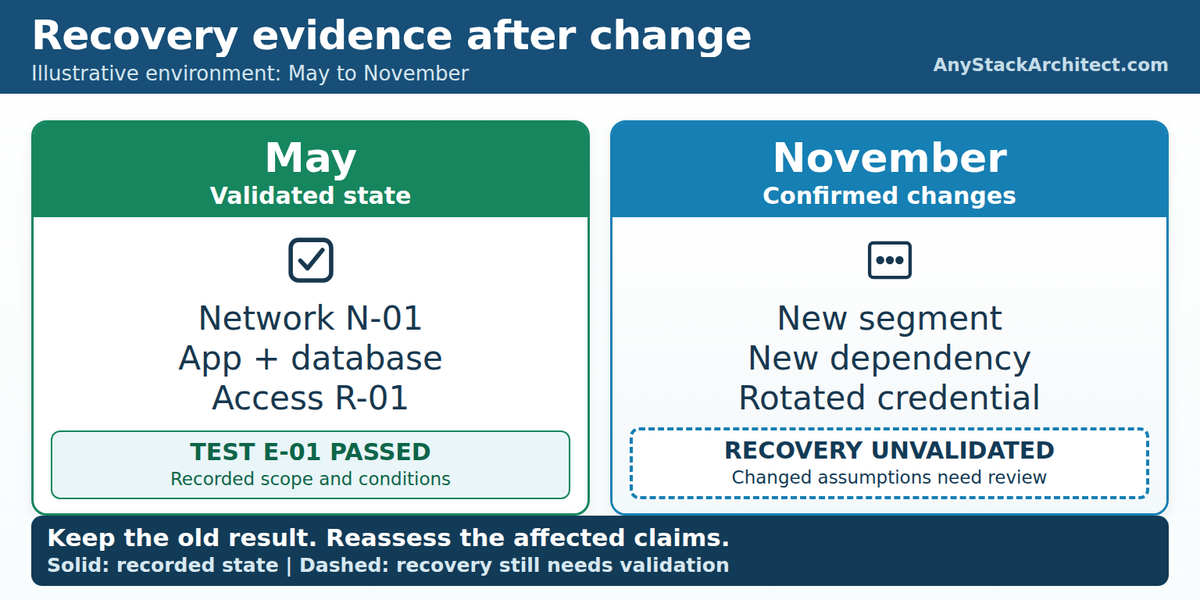
The last recovery exercise passed. The application started, users could sign in, and the team completed the agreed checks. Six months later, the test report is still in the folder. The production network has changed, the application has another database, and the service account in the runbook has been rotated.
I would keep that report. I would also stop using it as the sole evidence that the current service can recover.
A recovery exercise establishes what worked for a particular configuration, recovery point, procedure, team, and set of test conditions. Its value depends on knowing which of those conditions still apply. The problem starts when a result about the system that existed in May becomes an unqualified statement about the system running in November.
What the last test actually proved
A green status needs a defined meaning. Before deciding whether evidence has become stale, identify the claim it supported in the first place.
| Result recorded | What it demonstrates within the test scope | What remains to be demonstrated |
|---|---|---|
| Backup job completed | The configured job reported successful protection of its selected objects. | Restore usability, omitted dependencies, application consistency, and service access. |
| VM restore completed | The selected backup could instantiate the restored VM on that target. | Guest startup, application behavior, and external connectivity. |
| VM started | The guest reached the checked boot state. | Authentication, data correctness, dependency access, and user transactions. |
| Application checks passed | The tested functions worked with the dependencies and data supplied. | Untested workflows, production entry paths, sustained load, and failure conditions outside the exercise. |
| Business service accepted | The agreed business workflows passed under the recorded conditions. | Behavior after later changes and any excluded operating or failure conditions. |
| Failback validated | The tested return procedure, data handling, and acceptance checks worked. | A different destination, platform version, data history, or return method. |
Veeam's SureBackup job documentation makes one concrete distinction: full recoverability testing starts machines from backup in an isolated lab and tests running applications; backup verification and content scanning serve a different purpose. The available verification tests include predefined tests, backup file validation, and custom scripts. Those are documented capabilities in the VMware vSphere workflow. They don't establish that every application transaction or every recovery platform has been tested.
A recorded recovery duration needs the same qualification. An exercise may start its clock after infrastructure is provisioned, use a preselected restore point, and run without competing recoveries. Record the clock's start and stop events, preparation performed before the timer starts, workload size, concurrency, and the business acceptance criterion. Compare that observation with the RTO using the organization's agreed measurement boundary. Don't turn one favorable duration into a guaranteed future RTO.
RPO evidence also needs a data check. A backup timestamp says when a recovery point was created; the application owner still needs to establish which committed transactions are present and whether dependent datasets can be used together. A test of last month's data doesn't validate today's protection membership, restore-point availability, or data-loss exposure.
Production changed. Which assumptions moved?
NIST SP 800-34 Rev. 1, section 3.6, calls for contingency plans to remain aligned with system requirements, procedures, organizational structure, and policies. That provides a basis for maintaining the plan. The engineering work is identifying which subsequent changes affect the results used to defend it.
Production and recovery configurations don't have to be identical. A different subnet, smaller cluster, or alternate storage system may be intentional. Record the expected translation between them: production network to recovery network, application volume to recovery storage, production identity to approved recovery access. Compare current state with that designed mapping, rather than reporting every difference as a defect.
Keep three records separate: the intended recovery design, the configuration actually used during the last test, and the current observed configuration. Otherwise, an automated inventory refresh can overwrite the tested baseline and make an untested change look as though it was always approved.
Some assumptions change without a configuration ticket. Certificates expire. Data grows. A shared recovery cluster fills up. An administrator leaves. Vendor support ends. These events need a route into the same assessment process as planned infrastructure changes.
The network changes that leave restored VMs unreachable
A restored VM can attach to a network object that still exists while the application remains inaccessible. A VLAN may have been reassigned, the subnet moved behind another firewall, or a route changed on only one side of the connection. Matching a port-group name is insufficient evidence that the intended traffic path survives.
I would compare the actual recovery path from a representative client through DNS, VPN or private WAN, routing, firewall policy, load balancer, and application listener. Include the return path. A check performed from the recovery administrator's subnet can pass while the user network remains blocked.
IP changes can leave more than a stale address in the runbook. Firewall objects, NAT rules, DNS records, load-balancer pools, certificate names, and application allowlists may still refer to the previous endpoint. A login page can load even though a later transaction fails when the application calls an API from an unapproved recovery address.
Segmentation changes need both positive and negative checks. The recovered application should reach its permitted database and identity services; it should remain unable to reach prohibited networks. In multitenant DRaaS, that includes another customer's networks, overlapping address space, and provider management services. A successful connectivity test that quietly removed tenant isolation would be a failed recovery design.
Configuration comparisons can identify changed mappings and policies when the collector can read the relevant systems. Functional checks must then use the intended recovery source addresses, DNS view, access policy, and user path. Record any test-only route or permitted external dependency so the exercise doesn't borrow connectivity the real recovery would lack.
Identity, storage, and platform dependencies move too
Security changes need recovery follow-through
Credential rotation, stronger MFA, narrower privileges, and conditional access can improve security while making an old procedure unusable. The correction belongs in the recovery integration. Keeping an obsolete password alive or weakening ordinary access controls to preserve a runbook would create another problem.
Separate the identities involved. An operator may be able to open the recovery console while its service account cannot read a repository. A restored application may start while its database credential is stale. An Active Directory, DNS, time, federation, or certificate-trust dependency may prevent authentication even when the password is correct.
Expiry monitoring identifies dates, not successful authentication. Test the permitted operation through the intended recovery access path, including the necessary privilege and secrets retrieval. After certificate replacement, check the name, trust chain, and any configured pinning from the client that will actually use it. A certificate valid in production may still be untrusted by an isolated recovery client.
Microsoft's Entra emergency-access guidance includes validating authorized users, current procedures, sign-in, administrative actions, and monitoring. Apply the relevant platform guidance with the identity and security owners. An emergency procedure also needs reassessment when its custodian, device, authentication method, or access policy changes.
Encryption adds a dependency that ordinary backup success can conceal. Veeam documents different decryption paths and prerequisites for KMS-protected and password-based backups. Automatic access on an existing backup server doesn't by itself demonstrate that the intended recovery environment can obtain the required material. After a rotation or vault migration, verify the authorized recovery path for the retained restore points in scope. Don't place passwords or key material in the evidence register.
Platform changes can affect recovery and the return journey differently
A platform review should identify the exact operation being relied on: restore, cold boot, live migration, replication failover, storage migration, or failback. These operations don't share every compatibility requirement.
For example, Microsoft states that a Hyper-V VM configuration version cannot be downgraded after an upgrade. If a return plan depends on moving that VM to an older host, the configuration change deserves review before the next exercise. Microsoft's processor-compatibility guidance concerns running and saved-state moves; it shouldn't be turned into a blanket claim that a cold restore to different hardware is impossible.
Check backup-platform and integration versions against the selected recovery path. Veeam publishes separate platform requirements for VMware vSphere and Nutanix AHV. An upgrade review should use the installed combination, documented exceptions, and required features. A compatibility entry establishes supportability; a representative restore supplies operational evidence.
Cluster membership changes can alter usable compute capacity without changing the cluster's name. Check eligible hosts, CPU features, available memory, placement rules, and headroom for the expected concurrent recoveries under the assumed host-failure scenario. A removed host or a new placement constraint can leave enough aggregate capacity on paper but too few eligible targets. Recheck affected placement and representative load before reusing the earlier timing result.
Storage review needs the same specificity. Changed datastore or volume identifiers, SAN zoning, LUN presentation, multipathing, snapshot integration, repository permissions, or storage endpoints can affect where data is read and where recovered workloads write. Check capacity and performance for the expected recovery concurrency, including other tenants or services sharing the target. An unchanged mapping doesn't preserve a timing result if the target is now heavily contended.
A firmware or driver update doesn't automatically invalidate every earlier test. Assess whether it changes a relied-on storage path, transport, device capability, performance characteristic, or supported combination. A bounded update with no affected recovery dependency may need a recorded assessment and focused checks. A storage redesign or changed recovery method usually requires broader execution evidence.
The application changed without adding another VM
A new database, background worker, external API, identity integration, persistent volume, or startup prerequisite can change recovery without producing an obvious infrastructure alarm. A backup job that selects all VMs in a folder still won't explain whether the application now depends on a service outside that folder.
Update the dependency record when the application changes. Include the dependency's owner, protection or reconstruction method, recovery location, required access, acceptable data state, and startup condition. For external services, identify what the recovery team can control and what requires a provider or application-owner commitment.
Runtime service discovery is another dependency. From the recovery client, confirm that DNS or a service registry resolves the intended current endpoint and that the application can use it. If the application requires a registry, include its recovery, access, and startup requirements in the dependency record.
Traffic discovery can help find missing relationships. Microsoft's Azure Migrate dependency-analysis documentation also describes prerequisites, credentials, observation windows, and visibility limits. A connection map is evidence of what the tool observed. Cross-check it against application releases and owner knowledge so a monthly batch task or a rarely used API isn't silently omitted.
Kubernetes makes this especially visible. A restored workload definition can reference a different storage class, CSI driver, secret, image registry, admission policy, or external database than it did during the earlier exercise. The Kubernetes VolumeSnapshot documentation describes snapshot API objects and their CSI dependencies. The presence of those objects alone doesn't demonstrate that the required data and storage backend are recoverable.
Keep cluster-state recovery separate from application-data recovery. Red Hat's OpenShift 4.20 etcd recovery guidance requires an etcd backup from the same z-stream release for the documented restore operation. That is a version-specific example of why an upgrade can affect a recovery procedure. It is not a claim that restoring etcd restores the application's persistent-volume data.
When the runbook still reads well but won't execute
A runbook can be clear, professionally formatted, and wrong at step three. The system was renamed, the administrative interface was removed, the backup job now selects different objects, or the repository moved. The author remembers the workaround; the next operator doesn't.
Tie procedure steps to stable system identifiers and current role names where possible. Retain the runbook revision used in each exercise. When a job or repository changes, check object selection, access, restore-point discovery, and the procedure's actual destination. When a platform is retired, remove the dependency from every affected recovery and return step.
A second operator should execute the changed section using the documented access and escalation paths. A walkthrough can find an obsolete console reference or missing approval. It cannot prove that the referenced restore, data reconciliation, or failback operation will work. Record whether the step was discussed or executed.
Ownership changes deserve their own review. Who can authorize recovery? Who can approve a firewall change, obtain a key, accept the application's data, contact the vendor, or permit the return to production? A departed administrator's knowledge and access aren't an operating procedure.
For DRaaS, identify the customer/provider split for DNS, addressing, identity, application testing, security release, and failback. If that split changes, amend both the agreement and the executable handoff. Vendor lifecycle and licensing changes also require assessment when they alter access to a required feature, supported target, or assistance the recovery procedure assumes.
Six months of ordinary changes
Consider an illustrative order-processing service with an agreed 30-minute RPO and four-hour RTO. In its fictional May exercise, the team recovered the web, application, and database systems, restored the required identity services, and completed an agreed order transaction from a test client. The recorded configuration, runbook, and acceptance results form evidence set E-01.
Over the next six months, five changes occur:
The production application moves into a new subnet and security segment. The recovery mapping still points to the old segment.
A release adds a settlement database and worker. Neither appears in the recovery dependency list.
The database service credential rotates. Production uses the new secret, but the recovery procedure retrieves an older vault entry.
The virtualization platform is updated and recovery storage is reorganized. The runbook still names the previous target.
The document remains unchanged because each project was closed within its own team's scope.
At the next exercise, VM restoration could succeed while the service fails at several later steps. The client can't reach the expected endpoint, the application can't authenticate to its database, or order completion waits for the absent settlement service. The platform update might be entirely compatible. It still needs an assessment rather than an assumption that it caused, or could not have caused, a problem.
The table records the proposed response. It does not report completed retests or an actual customer incident.
| Changed dependency and prior evidence | What became uncertain | Detectable signal | Required validation and owner |
|---|---|---|---|
| Network mapping; E-01 used the old segment | Client access and permitted service flows | Mapping, IPAM, route, DNS, firewall, and load-balancer differences where collected | Network owner tests the revised path and isolation; application owner repeats the transaction. |
| Settlement database and worker; absent from E-01 | Dependency completeness, data consistency, startup order, and service RPO | Release inventory, discovered connections, backup membership, and owner review | Application and backup owners recover the added dependency and validate transaction and data behavior. |
| Service credential; E-01 used the earlier access path | Runtime authentication and secret retrieval | Vault reference/version changes; an authorized authentication probe can expose rejection | Identity and application owners exercise the approved access path and database operation. |
| Platform/storage; E-01 used the previous target | Supported placement, data access, capacity, and return procedure | Version inventory, storage mapping, path health, and capacity changes | Platform and storage owners assess compatibility, then execute affected restore, I/O, timing, or failback checks. |
A comparison of recovery mappings and protected inventory could have flagged the stale network and missing workloads before the exercise. It would not establish whether the new settlement database agrees with the recovered order database, or whether a transaction reaches completion with the restored service identity. Those checks require the application to run against the intended dependencies.
After individual corrections, repeat an integrated service test on the revised configuration. Otherwise, the team may have evidence that each component works in a different test environment without evidence that they work together. Keep the service's current recovery claim qualified until those acceptance checks pass.
Which changes should trigger another test?
I would assess a change against four questions:
- Which tested requirement or dependency does it touch?
- Which earlier result relied on the previous behavior?
- What execution could expose the resulting failure?
- How far could that failure spread through shared dependencies or the recovery sequence?
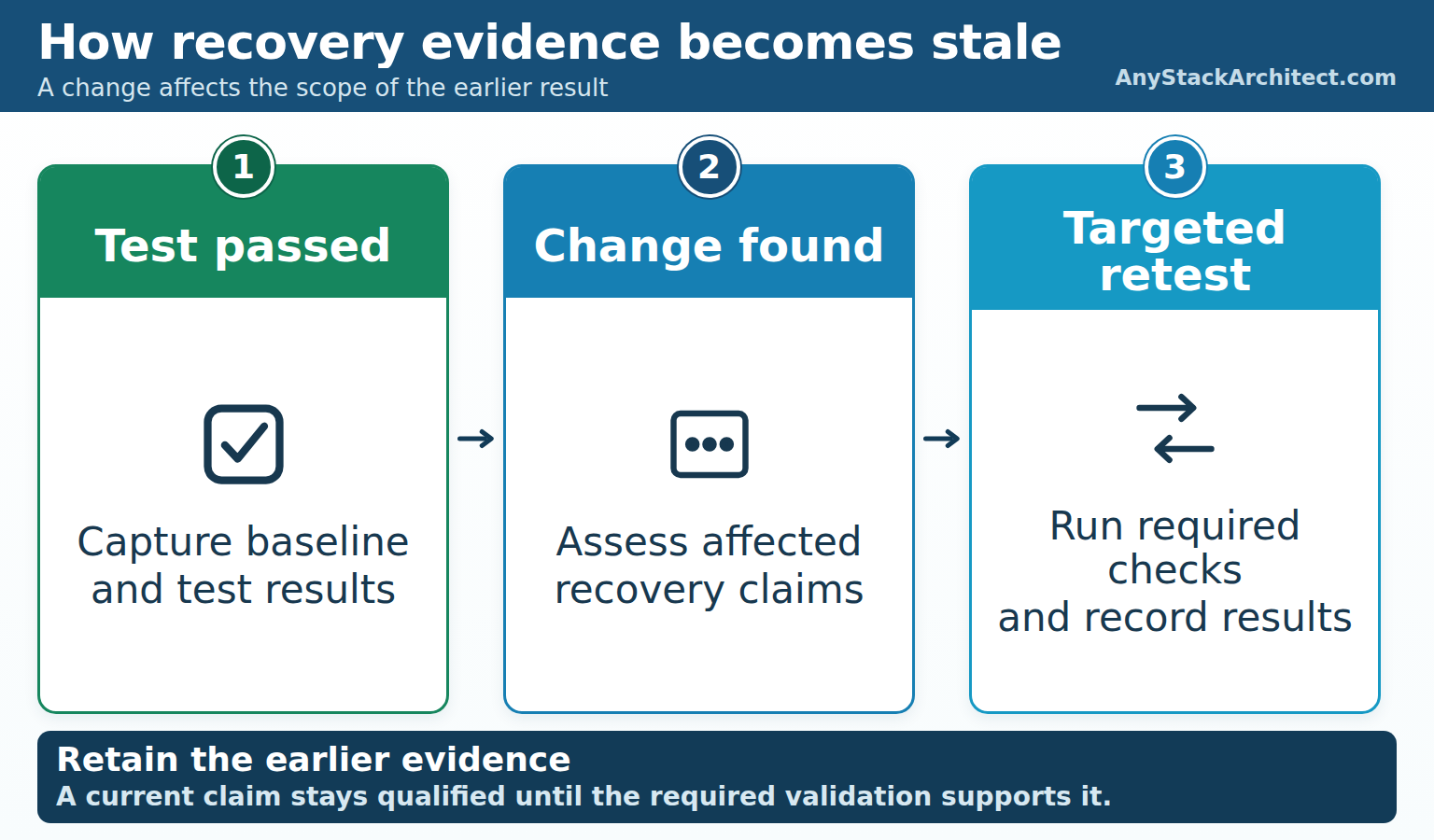
The unit of reassessment is the affected claim. A changed firewall policy may make the old client-access result inapplicable while leaving evidence that a particular backup could be read intact. A new database can affect the application's entire acceptance test. Assess a shared identity, storage, or network change across all dependent services.
NIST SP 800-128 describes configuration baselines, change-impact analysis, testing, verification, and retained history. Applying those practices to recovery evidence is an operational recommendation here, not a new certification scheme.
Use the smallest test that can credibly expose the affected failure, then widen it when interactions remain uncertain. A display-name change with unchanged identifiers and automation references may need a lookup and runbook check. A rotated credential needs the intended authorized operation. A changed application dependency needs functional and data checks. A new recovery network needs tests through the real recovery topology. A new failback method needs execution of that return procedure, including data reconciliation and protection restart.
A backup-platform upgrade deserves an assessment of the modes, plugins, repositories, and workloads actually used. Select representative restores for distinct paths; a single restored VM isn't evidence for unrelated database, agent, or container workflows. Record why the sample covers the affected population and which workloads remain outside it.
Use a broader exercise when the topology, shared dependencies, recovery sequence, target capacity, or failure scenario changes materially, or when the team cannot bound the impact. Several individually small changes can also interact. Isolated retests don't establish a service-level recovery time unless they reproduce the relevant sequence, concurrency, and acceptance boundary.
Urgent production changes may have to proceed before recovery validation. Assign an owner and deadline to the open recovery work, state the interim limitation, and escalate it to the accountable service owner. Risk acceptance documents that limitation; it doesn't turn an unexecuted test into a pass.
What continuous checks can and cannot prove
Automated comparison works best when it checks explicit expectations: each protected service has its expected workloads, each recovery mapping resolves, each repository is accessible through the intended path, and each monitored certificate or credential remains within its applicable lifecycle. Record collection time, coverage, permissions, and failures alongside the result.
A missing signal needs a status of its own. If the collector lost access to a firewall or stopped discovering a cluster, “no differences reported” cannot mean “unchanged.” New resource types, unsupported APIs, stale exports, and unmonitored providers create similar gaps.
Recording frequency also matters. The AWS Config RecordingMode API distinguishes continuous recording from daily recording, which represents the most recent state in a 24-hour period when it differs from the prior item. A daily state comparison can miss an intermediate state. Check the monitoring system's supported resources and collection scope before treating its output as a complete change history.
Keep passive comparison, active prerequisite checks, and recovery execution identifiable in the evidence. Inventory can show a missing network. An authentication probe can demonstrate one permitted operation. An automated recovery workflow can produce functional evidence when it actually restores the relevant workload and checks the intended behavior. Automation isn't the limiting factor; test scope is.
A successful application script that still checks last year's health endpoint can produce a current timestamp on stale acceptance logic. Version the checks with the application. Require the service owner to confirm that the transactions, data checks, and access paths still represent the business service.
Keeping recovery evidence current
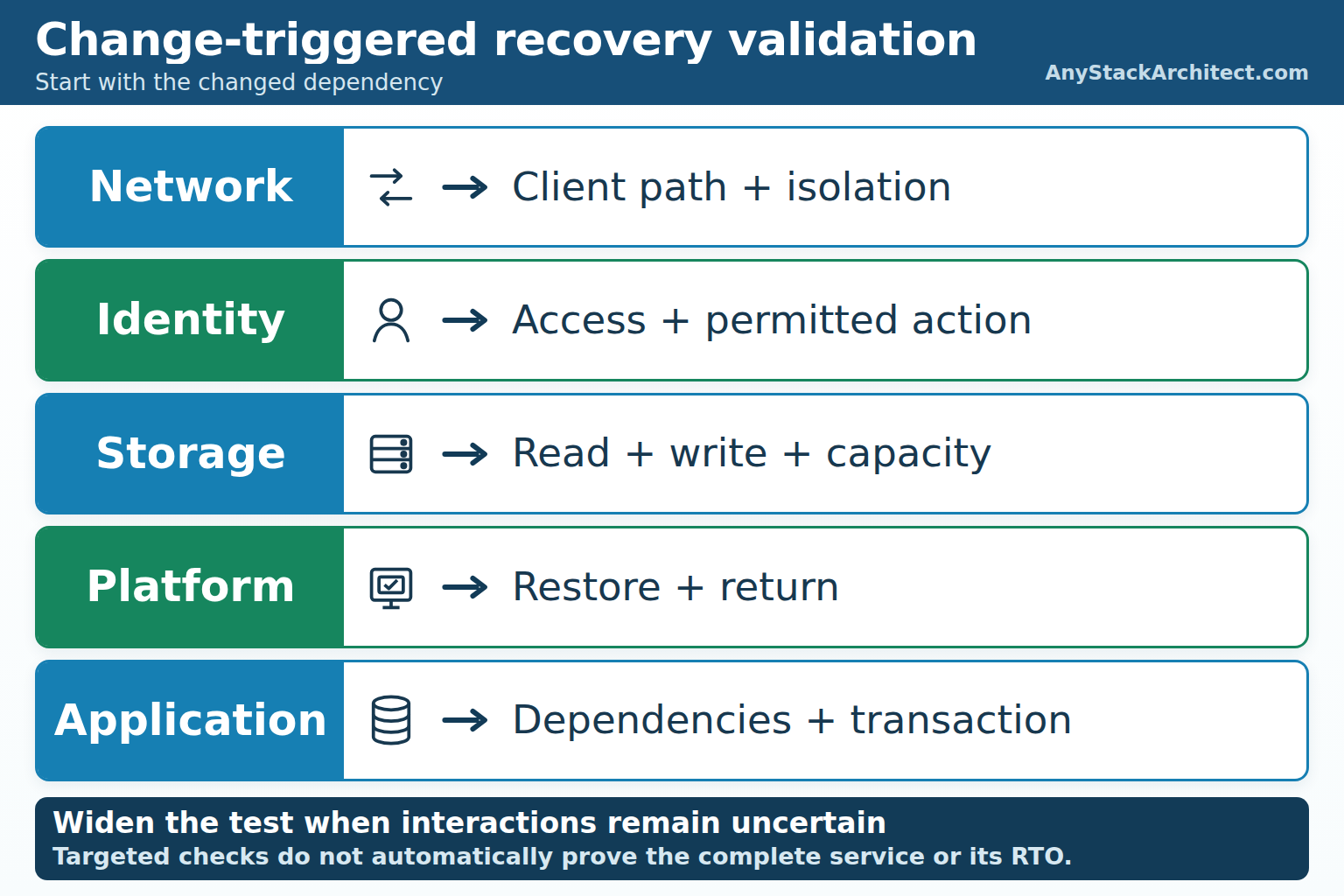
I would maintain a service record that connects the requirement to the test and the changes that followed it:
The record can live in an existing configuration, change, or service-management system. Store evidence in a controlled location and link to it; don't make a spreadsheet carry credentials, complete production exports, or sensitive logs.
For each service, capture the RPO/RTO requirement and measurement boundary, critical dependencies, tested configuration identifiers, procedure and test revisions, restore points, evidence timestamp, results, exceptions, and accepting owner. Each later change needs an affected-claim assessment, required retest, responsible owner, due date, and current assurance status.
Here is a shortened register for the fictional order service. Its requirement remains RPO 30 minutes and RTO four hours, with acceptance defined as the agreed order and settlement workflow through the recovery user path. Dates and evidence IDs are illustrative.
| Claim and last evidence | Subsequent change | Impact and next evidence needed | Owner | Current status |
|---|---|---|---|---|
| User access; E-01, May 6; network mapping N-01 | New segment and recovery mapping N-02 | Old path result doesn't cover N-02. Capture permitted/denied flows and application transaction results. | Network + application | Retest pending |
| Service completeness; E-01, May 6; dependency list D-01 | Settlement database and worker added | Recover both datasets and validate agreed consistency, startup, and transaction criteria against D-02. | Application + backup | Retest pending |
| Recovery authentication; E-01, May 6; procedure R-01 | Service credential and vault reference changed | Demonstrate authorized secret retrieval and database operation from recovery using R-02. | Identity + application | Retest pending |
| Placement and return; E-01, May 6; platform/storage baseline P-01 | Platform update and storage reorganization | Assess changed identifiers, compatibility, capacity, and return path; define and execute affected checks. | Platform + storage | Review required |
Preserve E-01 as historical evidence. Attach new results to the configuration and procedure they actually tested, with timestamps and enough logs or output for another engineer to inspect them. Protect the evidence history against silent overwrite; hashes can help detect changed files, but they don't prove that the recorded test was sound.
Use plain statuses with defined meanings. “Applicable within recorded scope” means the assessment has found no unresolved material change affecting that claim. “Review required” means impact is not yet understood. “Retest pending” means the required execution is outstanding. “Failed” records an unmet acceptance criterion. “Unknown” identifies missing evidence or collection coverage. None is a universal guarantee of recovery.
Make the recovery-impact question part of change completion, and reconcile it with observed configuration so changes outside the normal process still appear. Review approaching expirations, capacity trends, ownership transfers, support changes, and overdue retests. Schedule broader exercises according to service risk and obligations because dependency records and impact assessments can also miss things.
A credible current claim names the service, failure scenario, configuration, procedure, acceptance checks, and evidence that support it. It accounts for material changes since those checks ran and exposes any remaining limitations. When those links are missing, the honest statement is that the previous design passed its test and the changed design still needs validation.
Source Notes
Sources checked November 3, 2026. Vendor capabilities are documented behavior; the change-to-evidence model and retest choices are architectural and operational recommendations. The six-month service scenario is illustrative. No customer incident, lab measurement, or completed remediation is claimed.