
I keep seeing the same question boiled down to a compatibility checkbox: does the replication product support VCF 9?
At the platform layer, both vendors can point to support. Zerto 10.9 has a documented VAIO deployment path for VCF 9.0, and its current interoperability matrix lists ESXi 9.1. Veeam Backup & Replication 13 supports vSphere 9.1 and lists VCF as supported individual VMware software components.[1][2][8]
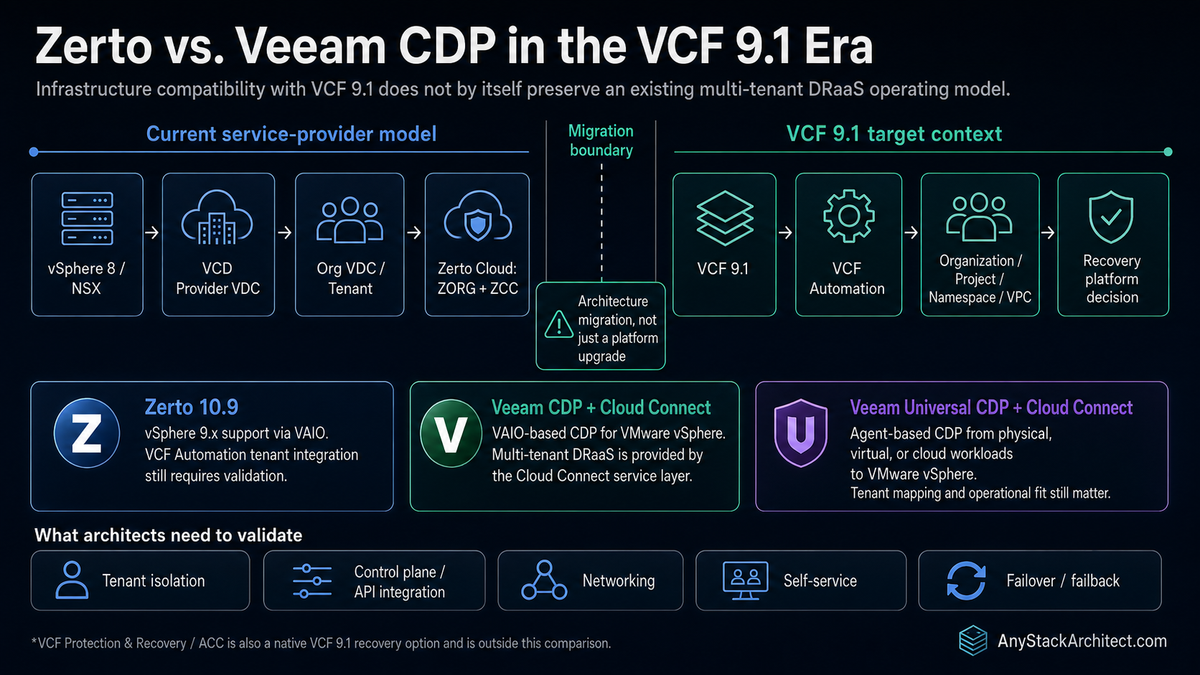
For a service provider, that still leaves the bigger question unanswered: whether an existing multi-tenant DRaaS service can move from vSphere 8 and VMware Cloud Director into VCF 9.1 without changing the control plane, tenant boundaries, network model, recovery workflows, or the way customers connect.
That's the part I care about. Change the tenancy layer and the DR architecture changes with it.
I went back through the current Zerto, Broadcom, and Veeam docs with that question in mind. I don't see a clean vendor win. Zerto still has real strengths in continuous protection and recovery orchestration, while its legacy provider model is the part under pressure.
Veeam can move the DRaaS resource boundary into Cloud Connect instead of VCD. Universal CDP moves source-side capture into the guest. Useful differences, yes. Neither one excuses the provider from redesigning and validating the service.
The VCF 9 migration changes the tenancy layer
Documented Broadcom was explicit about VCF 9.0: VMware Cloud Director was not supported, and there was no official VCD to VCF Automation migration path at that time.[4]
VCF 9.1 is a different case. Broadcom introduced a Migration Service intended to transfer VCD workloads and configurations into VCF 9.1, along with provider-oriented improvements around tenancy and self-service.[5] That finally gives providers an official migration direction out of VCD. It does not promise that every service construct carries over one for one.
It still isn't an in-place continuation of VCD. Broadcom documents migration topology limitations. One current example is a VCF Automation 9.1 migration failure when Provider VDCs on the same NSX-T Manager are backed by multiple vCenter Servers.[6] Broadcom also documents an HCX path where HCX registers directly with the underlying vCenter 8 source, bypasses VCD, and moves VMs into a VCF Automation Namespace.[7]
For a provider, this changes the project completely. VCD isn't just a portal. It may be where customer identity, resource boundaries, storage policies, networks, catalogs, APIs, and operational tooling all meet. If that is your environment, a live VCD and Zerto estate is a service-platform migration with customer waves and DR revalidation. Calling it a hypervisor upgrade understates the work.
Zerto: VCF 9 support is real. Provider continuity is the open problem.
Documented HPE Zerto's dedicated 10.9 VCF deployment guide is for VCF 9.0 and says that VCF 9.0 is supported only with the VAIO variant. The older Zerto zDriver is not supported in VCF-managed environments.[1]
Separately, Zerto's interoperability matrix, updated in August 2026, lists ESXi 9.1 under Zerto 10.9.[2]
Architecture inference I would not turn the 9.0 deployment guide into blanket proof for every VCF 9.1 provider topology. The exact Zerto, vCenter, ESXi, and VCF combination still needs to be validated before production.
Documented The interoperability material also sets an important boundary for this VCF path. The VAIO topology referenced by the current guidance is constrained to VMware-to-VMware replication.[2] I am not extending that statement to every Zerto 10.9 capability outside the VCF and VAIO topology.
The replication engine isn't my concern here. Carrying VCD, ZORG, and ZCC forward just because ESXi 9 is on the matrix would be.
Provider evidence 11:11 Systems put a very concrete example around this in July 2026. Its published DRaaS guidance says Zerto with VAIO is not usable in the 11:11 multi-tenant DRaaS service today because VMware Cloud Director and replication through Zerto Cloud Connector are unsupported in that service model.[3] That is one provider's implementation guidance, not proof that every Zerto topology fails. I still take it seriously because VCD and ZCC are exactly the pieces an existing provider may be depending on for tenancy and transport.
Architecture conclusion Public evidence does not establish feature-equivalent continuity for the VCD, ZORG, and ZCC operating model. I would not assume Org VDCs, Provider VDC mappings, tenant networks, ZORG boundaries, ZCC paths, self-service, billing integrations, or runbooks survive the move unchanged.
Field experience From the DR side, I still like Zerto's VPG and journal model. Grouping an application and its recovery behavior around a VPG makes more sense to me than pretending every VM is an island. That strength is real. It just does not answer the provider control-plane question, and good recovery mechanics do not make an unvalidated topology safe to sell as supported.
Veeam's provider answer is Cloud Connect, not just CDP
Documented Veeam Backup & Replication 13.1.1.18 supports vSphere and ESXi 9.x up to 9.1. Veeam also lists VMware Cloud Foundation, with the qualification that VCF is supported as its individual VMware software components.[8]
The CDP requirements are more specific. vCenter Server is required, standalone ESXi is not supported, source and target hosts use the Veeam I/O filter, and Veeam documents a maximum of 500 protected disks per ESXi host for CDP.[8]
The data path is tightly coupled to VMware. The coordinator asks vCenter to create the replica and applies the Veeam CDP storage policy. Source I/O filters intercept writes, CDP proxies move them, and a target-side I/O filter writes them to replica disks and transaction logs.[10] VCF 9 support does not make that I/O-filter lifecycle disappear.
The provider model sits above that data path.
Cloud Connect Replication gives the provider two relevant ways to expose a CDP target. It can allocate VMware vSphere resources through a hardware plan, or expose VMware Cloud Director Organization VDC resources as the cloud host.[14] A hardware plan is provider compute, storage, and network capacity allocated for tenant replicas; the tenant sees that allocation as a cloud host.[15]
With a standalone hardware plan, the Cloud Connect tenant account and plan become the DRaaS resource boundary. VCD isn't required for the target. For a provider trying to retire VCD, this is the Veeam model I would test first.
Use VCD Org VDC resources and the target tenancy boundary is still VCD. That's fine while VCD stays. It doesn't help you escape it.
I did not find current Veeam documentation mapping Cloud Connect tenant accounts or hardware plans directly to VCF Automation Organizations, Namespaces, or VPCs. I would treat that integration as unproven until the provider design is validated.
The third case is where I would slow down. Veeam documents VCF component support and Cloud Connect tenancy. I did not find current Veeam 13 documentation saying a Cloud Connect tenant is a native VCF Automation tenant or that a hardware plan is backed by a VCF Automation Organization, Namespace, or VPC.
Architecture inference A provider can reasonably evaluate VCF 9.1 as the supported vSphere infrastructure while Cloud Connect remains the DRaaS tenant and service plane. That gets VCD out of the Veeam tenancy dependency. It does not create documented native VCF Automation multi-tenancy. Before production, I would test tenant onboarding, networking, failover, failback, and provider operations in a lab and get the intended topology confirmed by Veeam.
Veeam also has a VCD-specific CDP path. Don't mix the models.
Veeam Backup & Replication also has a separate CDP for VMware Cloud Director workflow in the main product.[19] Cloud Connect can use VCD Org VDCs as CDP targets too. Its Cloud Connect documentation, however, says VMware Cloud Director is not supported as a source for replication to a VCD target.[18]
So I wouldn't lump every Veeam and VCD feature into one bucket. There is a VCD-aware CDP feature, a VCD-backed Cloud Connect target, and a standalone hardware-plan target. They do not have the same exposure when VCD leaves the architecture.
Universal CDP moves the source dependency into the guest
Universal CDP deserves a closer look because the name is easy to overread.
Documented Universal CDP can continuously protect supported virtual, physical, or cloud workloads and replicate them to a VMware vSphere host or cluster.[11] On the source, the Veeam CDP Agent Service and CDP Volume Filter Driver run inside the protected workload. Intercepted I/O goes to source CDP proxies, while the vSphere target still uses a VMware I/O filter for replica disks and transaction logs.[12]
That changes where the dependency lives. The source no longer has to be a VMware VM captured through a source ESXi I/O filter. It can be a supported workload on another virtualization platform, a physical server, or a cloud workload. The target is still VMware vSphere.
The trade shows up in operations. Universal CDP requires the in-guest service and filter driver, installed through protection groups with administrative credentials. Windows workloads require a reboot before Universal CDP works; Linux workloads do not.[13] Veeam also requires direct connectivity between source workloads and the backup server and documents workload limitations including 4Kn disks, CSV, Windows Storage Spaces, and powered-off workloads.[20]
Whether that trade is good depends on the service. Guest drivers, reboots, credentials, and direct source reachability may be acceptable. In some provider models they absolutely won't be. Universal CDP moves part of the complexity into each protected workload; it does not remove it.
Side-by-side architecture comparison
| Architecture area | Zerto 10.9 / VCF 9 VAIO path | Veeam CDP | Veeam Universal CDP |
|---|---|---|---|
| Replication capture | VCF 9 uses Zerto's VAIO variant. Legacy zDriver deployment is not supported in VCF-managed environments. | VMware I/O filters on source and target ESXi hosts, with vCenter and CDP proxies coordinating replication. | In-guest CDP Volume Filter Driver and Agent Service on the source. VMware I/O filter remains on the vSphere target. |
| Source scope | The VCF 9 VAIO path cited in current Zerto guidance is a VMware-focused topology. This does not describe every capability in Zerto 10.9 outside that VCF path. | VMware vSphere VMs. | Supported virtual, physical, and cloud workloads. |
| DR target | Supported Zerto VAIO VMware topology for VCF 9 must be validated against the current interoperability matrix. | VMware vSphere. In Cloud Connect, the cloud host can be backed by a vSphere hardware plan or VCD Org VDC. | VMware vSphere. In Cloud Connect, Universal CDP can target a cloud host backed by provider vSphere resources. |
| Multi-tenant abstraction | Legacy provider designs may depend on VCD, ZORG, and ZCC. Public VCF 9 evidence does not establish feature-equivalent continuation of that model. | Cloud Connect tenant account plus hardware plan, or a VCD tenant account plus Org VDC target. | Same Cloud Connect tenancy model as CDP. Source capture is decoupled from the source hypervisor object model. |
| VCD dependency | High in existing VCD, ZORG, and ZCC provider estates. That is the migration risk. | Optional on the target. Hardware-plan Cloud Connect does not require VCD; VCD-backed cloud hosts do. | Not required for source capture or a hardware-plan target. VCD-backed Cloud Connect remains optional. |
| VCF Automation relationship | No public evidence reviewed here establishes a drop-in replacement for the old VCD and ZCC provider model. | Veeam supports VCF as VMware components, but native Cloud Connect mapping to VCF Automation tenant objects is not documented in the sources reviewed. | Same documentation gap on the provider side. Universal CDP changes source capture, not the provider tenancy model. |
| RPO model | Continuous replication with journal-based recovery. | Short-term restore points can be configured down to 2 seconds; Veeam documents 15 seconds or more as the optimal setting and allows up to a 60-minute configured RPO. | Same documented 2-second minimum, 15-second or greater recommended optimum, and 60-minute maximum policy RPO. |
| Retention model | Journal and checkpoints. | Short-term journal restore points plus scheduled long-term restore points. Standard vSphere CDP documentation caps the short-term journal at 168 hours. | Short-term transaction-log restore points plus scheduled long-term delta points. Current considerations document up to 95 long-term restore points per disk. |
| Provider networking | Existing service-provider designs may depend on ZCC for customer-isolated replication transport. That dependency must be resolved for VAIO-based VCF 9 designs. | Cloud Gateway, hardware-plan VLANs, and network extension appliances for built-in cloud networking. VCD-backed targets use a different Org VDC and NSX Edge model. | Same Cloud Connect network model, plus source workload connectivity required for agent-based capture. |
| Self-service and recovery | Zerto has mature VPG, journal, failover test, live failover, and reverse-protection workflows, but provider self-service continuity depends on the supported multi-tenant topology. | Tenant can create policies and run failover from the tenant VBR server. SP can run full-site failover. Cloud Connect provider infrastructure does not support custom RBAC roles. | Universal CDP supports failover, failover plans, permanent failover, undo, and failback. When the target is a Cloud Connect cloud host, provider recovery still uses the Cloud Connect service model. |
| Operational coupling | Provider risk is concentrated around replacing VCD, ZORG, and ZCC dependencies while preserving customer service behavior. | vCenter, ESXi I/O filters, CDP proxies, cloud gateways, tenant accounts, hardware plans, and network extension appliances all become lifecycle objects. | Adds per-workload agent and filter deployment, credentials, source reachability, and Windows reboot requirements to the Cloud Connect target stack. |
| Migration risk from existing VCD DRaaS | Architecture assessment: high when VCD and ZCC are embedded in tenant isolation or transport. Side-by-side migration and vendor sign-off are warranted. | Architecture assessment: lower if the existing service already uses standalone Cloud Connect hardware plans. Still significant if the target model is VCD Org VDC based. | Architecture assessment: can reduce source-platform coupling, but the provider still has to validate the VCF 9.1 vSphere target, networking, failover, and service-plane design. |
I kept documented behavior separate from architecture conclusions in the table. "Not documented" does not mean "unsupported." Where the vendor material did not establish a VCF Automation integration, I left the gap visible instead of filling it in myself.
Networking is where the cleaner Veeam story gets less clean
Cloud Connect can own the DRaaS tenancy layer without VCD. Good. The provider network still has to be built and operated.
Documented With a hardware-plan design, Veeam allocates tenant networks from provider VLAN ranges and deploys network extension appliances for built-in cloud networking and failover. A tenant using both full and partial failover needs a provider-side appliance plus tenant-side appliances, with a separate tenant-side appliance for each production IP network.[16] The provider-side appliance separates provider and tenant traffic with VLANs and individual VPN tunnels.[16]
The firewall model is manageable, but it is real. Current Cloud Connect documentation uses TCP and UDP 6180 as a core tenant-to-cloud-gateway transport. CDP adds provider coordinator and proxy ports, while network extension uses UDP 1195 with additional odd ports for extra tenant IP networks.[17]
At provider scale, that belongs in the architecture drawing and the firewall matrix. It should not show up as a surprise after the service is sold.
A VCD-backed Cloud Connect target changes the mechanics again. Veeam documents Org VDC networks and an NSX Edge gateway for full-site failover. It also notes that provider network extension appliances are not used for internet access after full-site failover in that VCD scenario.[21]
I still would not say Veeam 'solves' multi-tenancy. It gives the provider another place to anchor it. Hardware plans, tenant accounts, VLANs, Cloud Gateways, and network extension appliances replace VCD as the service-provider abstraction. That can fit a VCD exit much better, but the operational burden is still yours.
Recovery workflow: both products are mature, but the control boundaries differ
Veeam CDP and Universal CDP both use short-term and long-term restore points. For vSphere CDP, Veeam documents journal-based short-term restore points for up to 168 hours, with older recovery states represented by scheduled long-term restore points.[9] Universal CDP uses a similar transaction-log and long-term delta chain, but source capture comes from the in-guest filter.[12]
Current Veeam policy documentation sets a 2-second minimum RPO for both CDP types, calls 15 seconds or more the optimal setting, and allows up to a 60-minute configured RPO.[22][23] Short-term points are crash-consistent. Scheduled long-term points can use application-aware processing where supported.
Cloud Connect adds provider-aware recovery behavior. A tenant can build a cloud failover plan, and the plan is stored on the provider backup server so the provider can run it if the tenant's Veeam server disappears with the production site.[24] Veeam documents testing for cloud failover plans containing CDP replicas, planned failover for cloud CDP replicas, full-site and partial-site failover, permanent failover, and failback.[24][25][26]
Universal CDP also has documented failover, failover-plan, permanent-failover, undo, and failback workflows.[29] When it is delivered through a Cloud Connect cloud host, those product features still sit inside the provider's Cloud Connect tenant and network design.
The control boundary matters. Veeam documents failback as tenant-side only for cloud replicas. A provider can run full-site failover, but cannot perform tenant failback from the provider console.[24] Cloud Connect also does not support RBAC that assigns tenants custom roles over provider cloud infrastructure.[27] Its documented subtenant model covers cloud-repository and agent-backup quotas, so I would not present that as granular replication RBAC.[28]
I would not call Veeam's self-service model universally better. Tenants get useful recovery control, but the delegation boundary is real.
Zerto's recovery workflow is not the weak point. Preserving the provider service around it is. Test recovery, live recovery, journal checkpoints, and reverse protection only matter if the replacement VCF 9 topology keeps the tenant boundaries and connectivity those workflows rely on.
Which architecture handles the VCD exit better?
Of the four cases here, this is the transition I would treat with the most caution. The replication engine has a VCF 9 path; the legacy service-provider abstraction is what is not proven to carry forward. I would keep production intact and build VCF 9.1 beside it. Before a production tenant wave, I would want HPE Zerto to validate the replacement for VCD, ZORG, ZCC, tenant isolation, and customer self-service, then I would prove the full recovery lifecycle myself.
The standalone hardware-plan model is the cleanest Veeam fit I found for a provider leaving VCD. Tenant identity and DR resources live in Cloud Connect instead of VCD Org VDCs. The catch remains: Veeam does not currently document VCF Automation tenant objects as the Cloud Connect abstraction. You are deliberately operating two control planes.
A VCD Org VDC target does not get you out of the VCD migration problem. It is a clean VCD-aware model while VCD stays, but the Org VDC remains the target resource boundary. Moving to VCF Automation still needs a new target architecture and tenant mapping.
Universal CDP gets interesting when the provider wants low-RPO protection for supported workloads that are not all VMware VMs. It avoids source-side ESXi I/O filters and source VCD object dependencies. In exchange, you take on guest drivers, lifecycle management, Windows reboot requirements, direct source connectivity, and workload-level compatibility limits. Different trade. Not a free one.
How I would validate a provider target before committing customers
I don't see a tidy winner here. Zerto has a real VCF 9 VAIO path, but an existing VCD and ZCC provider model creates a serious multi-tenancy transition problem. Veeam's strongest architectural advantage is Cloud Connect's ability to hold the DRaaS resource boundary in Veeam through standalone tenant accounts and hardware plans. That can reduce VCD coupling. It still is not documented native VCF Automation tenancy.
Universal CDP changes the source side again by making the protected workload the capture point instead of the source hypervisor. That is useful for mixed-platform providers. The target is still VMware, and the Cloud Connect network and service plane still need real engineering.
My rule for this migration is simple: choose the multi-tenant control plane you actually intend to operate, then make the replication product prove it fits that service. If you start with the hypervisor compatibility checkbox and work outward, this is exactly the kind of DRaaS dependency you miss.
Key Takeaways
- Zerto 10.9 has documented VCF 9 VAIO platform support, and the current interoperability matrix lists ESXi 9.1. That still does not prove continuity for an existing VCD, ZORG, and ZCC multi-tenant DRaaS model.
- VCF 9.1 gives service providers a real VCD migration path, but it is still a migration of tenant and network constructs rather than an in-place continuation of VCD.
- Veeam Cloud Connect can provide multi-tenancy through standalone tenant accounts and hardware plans without making VCD the target control plane. That is the clearest Veeam advantage in a VCD exit.
- Veeam CDP remains VMware-integrated through vCenter, ESXi I/O filters, and CDP proxies. VCF 9 support doesn't remove those lifecycle dependencies.
- Universal CDP removes the source ESXi I/O-filter dependency by capturing I/O inside the workload, but the recovery target remains VMware vSphere and the agent lifecycle becomes part of operations.
- Current Veeam documentation reviewed for this article does not establish native Cloud Connect mapping to VCF Automation tenant objects. That point is ambiguous and should be validated, not assumed.
- If a provider's current Zerto service depends on ZCC for customer transport and isolation, resolve that supported replacement before moving production tenants.
Source Notes
Support matrices move. I checked the product claims in this article against public vendor material available on September 2, 2026.